Nine Pots, One Lamp, No Mercy: A Colchester Paint Rescue Clinic
Photo: Loulou Damman, CC BY-SA 4.0, via Wikimedia Commons
There is a particular sound a dead acrylic pot makes. You shake it and instead of the crisp rattle of a mixing bead you get a dull thunk, like a man patting his pockets for keys he knows aren't there. Most of us have three or four of those lurking at the back of the drawer, along with a vague plan to deal with them "after Christmas".
This month we dealt with them before Christmas and made a club night of it.
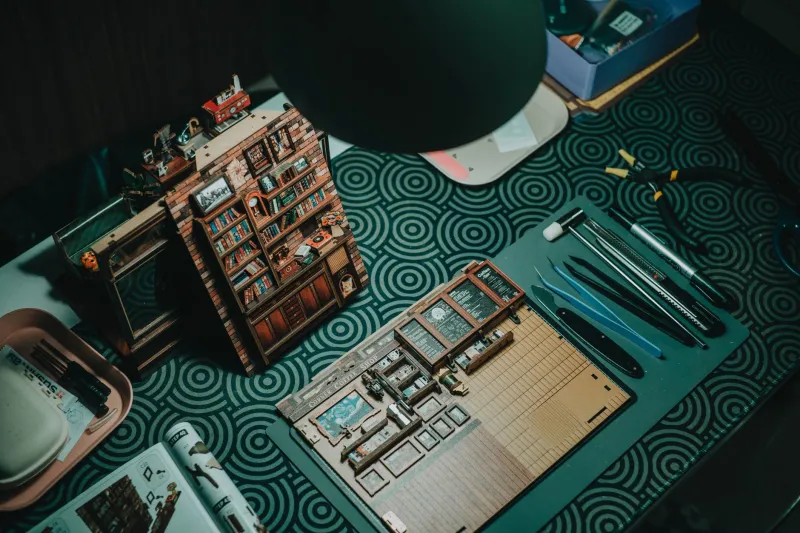
The premise was straightforward. Everyone brought their crustiest pots — rims sealed solid, labels long gone, colours that might be a faded Dark Earth or might be gravy granules. We put them out on two tables under the same lamp, the club's old anglepoise with the 6400K LED we use for judging, and worked through them in a fixed order rather than by feel. Nine pots made it through the full process. Two are now back in service. Four are usable with caveats. Three went in the bin, and nobody argued.
Setting the Ground Rules
We agreed three things before opening the first lid, and they're worth passing on because each one stopped an argument later.
First, no thinner went into a pot until a sample had been decanted onto a white tile. Acrylics do unexpected things at the bottom of a jar, and a rescue attempt that ruins a paint you actually needed is a net loss.
Second, everything was judged wet and dry. A paint that looks fine wet can dry to a chalky film, and a paint that looks lumpy wet can settle down beautifully once it's on a surface with a bit of tooth. We used offcuts of the club's usual grey card for swatches.
Third, we wrote down what went into each pot. This sounds fussy until the fourth person asks whether the green one got flow improver or washing-up liquid.
What We Actually Tried
Plain water, and why it's the weakest tool in the box
Every one of us started here, and it worked on exactly one pot — an old brush-on primer that had only lost its water to a loose lid. Distilled water, a stir with a cocktail stick, ten minutes of standing, and it was back. Tap water did the same job but left a faint scum on the swatch when it dried, which is the sort of thing that turns up later under varnish.
Water revives a paint that has simply dried out. It does nothing for a paint whose binder has started to coagulate.
Acrylic thinner versus flow improver
This was the useful part of the evening. Thinner is a solvent-ish helper that gets pigment and binder moving again; flow improver is a surfactant that breaks surface tension so the paint levels out. They are not interchangeable, and using flow improver to resurrect a half-set pot is a bit like trying to unstick a door with furniture polish.
On the four borderline pots, a few drops of proper acrylic thinner plus a good stir brought three back to a workable consistency. The fourth turned grainy and never recovered — once pigment particles clump together like that, no amount of stirring unbinds them.
Flow improver earned its place in a different way: added after the rescue, at about one drop per ten of paint, it stopped the revived paint from drying with visible brush marks. That matters on a 1/72 airframe where every ridge shows.
What we didn't use: isopropyl alcohol. One member had tried it in the past and got a curdled, stringy mess from a well-known water-based range. It works on some formulations and destroys others, and unless you're willing to sacrifice the pot, save it for cleaning.
The agitation question
Rim crust is a separate problem from interior crust, and it's the one that keeps a pot dead even after the paint inside is fine. Scraping the thread with a scalpel got most of them open, though two lids needed a wipe of hot water around the seal and a patient five minutes before they'd budge.
Inside the pot, the club consensus favoured stainless steel mixing beads over glass — they're heavier and they don't shatter if you drop the jar on a stone floor, which at least one of us has done. We added two beads to any pot that rattled weakly and shook by hand for a full minute. One member's cheap vortex mixer got a lot of admiring looks and did a faster job, but the hand-shakers weren't far behind.
The ultrasonic cleaner sitting in the corner was the most divisive item on the table. It loosened stubborn sediment better than anything else, but it warms the paint, and warm acrylic in a sealed jar is a step away from a skin forming on top. If you try it, keep the pot in a bag, keep it short, and don't leave it running while you go and get a coffee.
The Pots That Stayed Dead
All three casualties shared a feature: when we opened them, the contents had separated into a rubbery plug sitting in a puddle of clear liquid. That's a binder that has well and truly gone. Colour-wise they were all generic — a black, a white, a mid-grey — and none of us felt the loss. Cheap to replace, no sentiment attached.
The harder call was a part-used pot of a specific RAF green that had belonged to a member for years. It stirred up, it looked right on the swatch, and it dried a shade and a half lighter than the model it was meant to touch up. We retired it. A revived paint that doesn't match the model it was bought for is just a small jar of disappointment.
The Triage Rule
Before you put anything in the January basket, run this on each suspect pot. It takes about ninety seconds.
Does it rattle? A genuine rattle means liquid is still moving in there. A thunk means you're dealing with a plug, and plugs are usually terminal.
Does it stir smooth? Add thinner to a decanted sample, stir, and look at it on a white surface. Smooth and even means it's alive. Gritty, stringy or curdled means it's gone, whatever the label says.
Does it smell of acrylic? Faintly plasticky and slightly ammoniacal is normal. Sour, cheesy or faintly like a pond means bacteria have moved in, and no thinner is fixing that.
Fail two of the three and the pot goes. That's it — no sentiment, no "I'll try it on a scrap model first". Hobby budgets in this house get reset in January like everyone else's, and a tenner saved on paint that was never coming back is a tenner for a kit that actually will get built.
Next club night is the December social, so bring your rescued pots and a model with a bit of revived colour on it. If it dried badly, we'd rather find out on the table than six months later under a coat of varnish.