Finished, Warts and All: The A1 Attitude That Beats a Perfect Stash

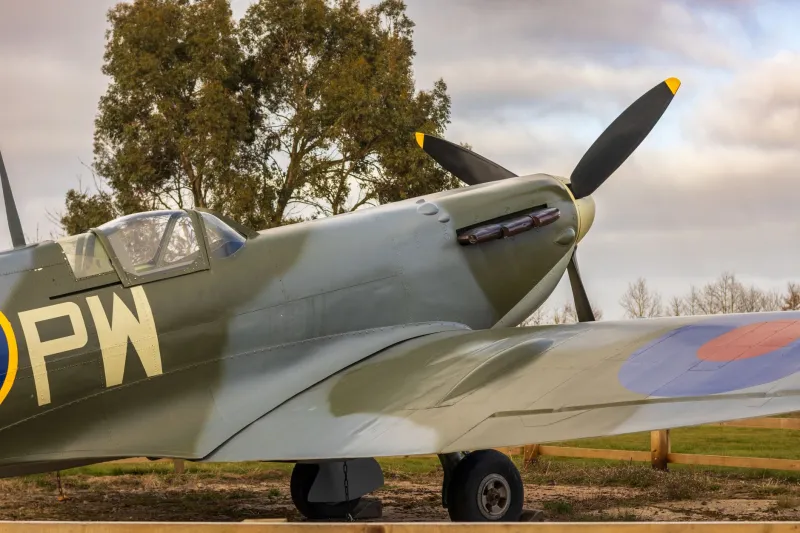
Photo: Michael Barera, CC BY-SA 4.0, via Wikimedia Commons
On the third Tuesday of every month, a group of us take over the back room of a Colchester community hall, unpack whatever survived the commute, and get building. There is always a moment when someone lifts a finished model out of a Really Useful Box and the table goes quiet. It is rarely the cleanest build in the room. It is almost never the most expensive. But it is finished, and that counts for more on our bench than a cupboard full of untouched limited editions.
The shelf of doom is not a badge of honour
Every club has one: the modeller with a spare room that looks like a hobby shop. They can tell you the moulding history of a 1970s Airfix kit, the best aftermarket cockpit for a Tamiya Spitfire and exactly why the new-tool Hurricane is worth the extra tenner. What they cannot always do is show you something they finished this year.
The stash becomes a personality. It is easy to talk about the kit you are saving for a rainy day, the one that needs the right decals, the one that will be perfect when your skills are better. At Colchester A1 Models we are not anti-stash. A small pile of kits is a reasonable thing for a hobbyist to own. But there is a difference between buying for the future and hiding from the present. The best builders in Colchester are not the ones with the biggest stash. They are the ones who finish badly, learn something, and finish again.
What finishing badly actually looks like
Dave brought an Airfix 1/72 P-51D Mustang to a recent bench night. The wing-root seam was visible from across the table. He knew. He pointed it out before anyone else could, then put it down next to his coffee and asked what to do differently on the next one. That is the A1 attitude. The model existed. It had paint, decals and a slightly wonky prop. It also had a lesson attached.
Sarah's Revell 1/72 Spitfire Mk.V had a fogged canopy corner because she used too much poly cement. She was not thrilled about it, but she had masked the canopy herself, brush-painted the upper surfaces and got the roundels on straight. She has already started a second one. The fogged canopy taught her more about glue control than any forum thread could.
Tom's Tamiya 1/35 German half-track was finished with a mud effect that looked suspiciously like it was hiding a melted weld line. It was. He had attacked the seam with too much solvent, sanded it flat, lost some detail and then decided to keep going rather than bin it. The mud was heavy, the tracks were slightly crooked and the whole thing looked like it had come out of a very bad day in the Ardennes. It also looked finished, and it got more attention than the pristine unbuilt kits under the table.
A finish-first routine for a Colchester bench night
None of this is revolutionary. It is just a refusal to let perfect be the enemy of done. Here is the routine we keep coming back to.
- Pick one box. Not five. Not the one you are saving for a competition. One kit you can reasonably finish in a month.
- Timebox it. Ninety minutes at bench night, then stop. Progress beats marathon sessions that end in frustration.
- Build in subassemblies. Wheels, tracks and canopies can wait. Do not detail what will never be seen.
- Use the three-flaw rule. Accept that the finished model will have at least three visible flaws. A seam, a silvered decal, a slightly off centre tyre. Finish anyway.
- Paint with what you have. A brush and a tin of Humbrol is fine. A rattle can in the garden is fine. You do not need an airbrush to learn brush control.
- Treat decals like a skill, not a sticker. Gloss coat, setting solution, softener if needed, then a flat coat. If one silvered, you learned why.
- Weather once. A clay wash and a bit of pigment dust will hide more sins than another coat of paint.
- Base it. A piece of card and some static grass makes a finished model look intentional.
Why the stash-hoarders lose out
Buying a kit is a promise. Building it is a risk. The promise is comfortable: this kit will be great when I have the right references, the right tools, the right amount of free time. The risk is uncomfortable: I might ruin it. I might find out my seam work is not as good as I thought. I might have to ask for help.
That is exactly why finishing matters. A finished model is evidence. It shows what you can do today, not what you might do in some imaginary future when the bench is tidy and the aftermarket set has arrived. The modellers we respect most in Colchester are the ones who bring evidence.
If you are reading this with a shelf of doom behind you, here is a challenge. Pick one kit from the pile this week. Not the most expensive, not the most important, just one. Finish it by the next bench night and bring it in, even if the seam is ugly. Especially if the seam is ugly.
The club verdict
At the end of bench night, the models that get picked up and examined are the finished ones. People ask how the paint went on, how the decals behaved, whether the mud was too much. A wobbly wing that exists teaches more than a perfect wing that does not. That is the A1 attitude: finish first, refine later, and let the next build be the better one.