Shrink the Bench, Not the Ambition: How 1/144 Took Over Colchester Spare Rooms
Photo: tiny 1/144 scale model aircraft displayed on a shelf next to a paintbrush, via i.pinimg.com
The first time somebody brings a 1/144 kit to club show-and-tell, the reaction is usually a polite version of "is that it?" Six centimetres of Spitfire on a paper plate beside a 1/32 monster. Then you lean in and notice the panel lines are there, the canopy frames are painted cleanly, the exhaust staining is in exactly the right place — and the whole thing was finished in a fortnight.
That's the pitch. And it's why small scale is quietly colonising benches across Colchester.
The housing reality
Be blunt about it: the average spare-room bench in this town isn't a workshop. It's the end of a desk in a back bedroom in New Town, or the corner of a converted loft up in Lexden, or a folding table in a Stanway spare room that has to become a guest bed twice a year. Wall space is at a premium, shelving is whatever fits, and the display-cabinet question — where does the finished thing actually go? — is the one that quietly ends most builds.
A 1/72 four-engine bomber is roughly half a metre of shelf. In 1/144 it's a quarter of that. Suddenly you can build the subject you genuinely want and still have somewhere to put it, which sounds mundane until you realise it's one of the most common reasons projects stall halfway and end up in the bin bag of shame.
What the club table is telling us
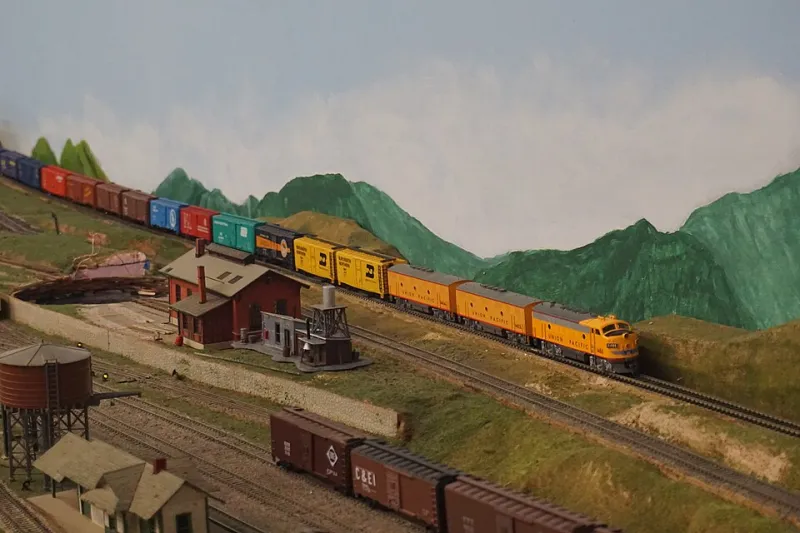
Over the last couple of club seasons the show-and-tell table has changed shape. Fewer big single builds, more small clusters — a 1/144 jet and a Sabre side by side, a pair of tiny armour pieces mounted on a bit of card, a little diorama that fits in a shoebox. Members who used to finish one kit a year are turning out four.
Part of that is time. Part of it is that a small kit which goes wrong costs you a weekend rather than a month, so you're willing to try things. A wash, a chipping technique, a new masking method, a base with actual ground texture. The stakes are low enough to experiment, and experimenting is where the skill actually comes from.
Small is hard, and that's the good bit
Let's not pretend 1/144 is the easy option. It's differently hard.
Construction is faster, but the tolerances are unforgiving. A fraction of a millimetre of misalignment at the wing root is visible at this size, and filler work has to be surgical rather than generous. Panel detail is finer and shallower, so a heavy wash that looks moody at 1/48 makes a 1/144 kit look like it's been dragged through a puddle. And the decals — the decals are small enough that a misplaced roundel is a genuine disaster, because there is no room anywhere to hide it.
That's the trade. You give up the pleasure of a big, mechanical, open-panel build. You get repetition, speed, and a stash that fits in a shoebox.
Gear that actually earns its place
You don't need much, but you do need to be able to see.
- Magnification. A clip-on loupe, a headband visor, or — the club-night favourite — a pair of cheap +3.00 reading glasses from the chemist. Try them on before buying; working distance matters more than the number on the label.
- A bright, close lamp. Daylight-balanced, and positioned so your own hand doesn't shadow the part. This is the single biggest quality-of-life upgrade at this scale.
- Fine brushes that hold a point. A 0 and a 00, plus one decent 10/0 for canopy frames. Cheap brushes will splay and ruin your evening.
- Tweezers with fine, flat tips. For decals, for tiny photo-etch, and for retrieving a part you've just dropped for the fourth time.
- A clean, light-coloured surface. Small parts on a dark cutting mat are effectively invisible.
Painting a canopy you can barely see
The canopy is where most people decide 1/144 isn't for them, and it's also where the trick is simplest.
Dip the canopy in clear gloss and let it dry under a cover — it makes the plastic behave more like glass and gives the frame something to grip. Then either use a pre-cut mask if the kit supplies one, or lay thin strips of tape along the frames and burnish them down hard with a cocktail stick. Paint the frame colour in thin, almost dry coats, let it cure properly, then lift the tape. Flood it and the paint will wick under the mask, and you'll spend an evening with a toothpick and a bottle of isopropyl.
If masking sounds miserable, a fine brush and a steady hand over a glossed canopy works surprisingly well. Slight wobble is invisible at arm's length — and arm's length is how these things are actually viewed.
The trade-offs, stated plainly
- Detail is shallower, and shallow detail wants a lighter touch throughout.
- Some 1/144 kits are beautifully engineered; others are elderly moulds with soft edges. Research before you buy.
- Per-kit cost is often similar to 1/72, so this isn't a money-saving exercise — it's a space-saving one.
- Tiny parts and carpet are natural enemies. Work over a tray.
- Aftermarket is thinner on the ground, though it's improving steadily year on year.
A starter shortlist
If you fancy trying it without committing, these are the sorts of kits that turn up at club nights and on UK show tables with good reputations:
- A modern 1/144 Spitfire from one of the Czech makers — well-fitting, and it behaves like a much bigger kit.
- Sweet 1/144 Hurricane or P-51 — small, sharp, and often two kits in the box.
- A 1/144 Lancaster — the "I want a bomber on the shelf" option, and a fair test of your canopy masking patience.
- Zvezda 1/144 armour — the T-34 and friends, cheap enough to use as painting practice.
- Academy or Platz 1/144 jets — solid entry points if modern subjects are your thing.
- Anything with a single-piece canopy — fewer frames, fewer problems, and a genuinely good place to start.
Buy one, not six. That's the trap: at this size a stash of ten feels entirely reasonable, and then you've recreated the shelf problem you were trying to solve.
Downsizing without downscaling the ambition
The pitch, in the end, is simple. Same subject, same research, same satisfaction when the camouflage finally comes together — just at a size that fits the room you've actually got. The modelling is identical. Only the shadow you cast over the bench changes.
Bring one to the next club night. Somebody will ask if that's it. Then somebody will lean in.